AI's Bobby Tables Moment, Why Bad AI Implementations Cause Disasters
Disasters in the implementation of new technologies sometimes come from rushing the implementation of technology and not from the technology itself.

Disasters in the implementation of new technologies sometimes come from rushing the implementation of technology and not from the technology itself.
I've come to this conclusion based on my observatoin of the disasters experienced by organizations implementing AI in their business, the same way organizations had problems during the early implementations of databases twenty years ago. If we look carefully we can see clearly how history repeats itself. With every new technology, for some reason we keep repeating the same mistakes. Organizations are too quick to implement AI in their business, and somewhere between the demonstration and the deployment, applying guardrails were forgotten.
What or Who Is Bobby Tables?
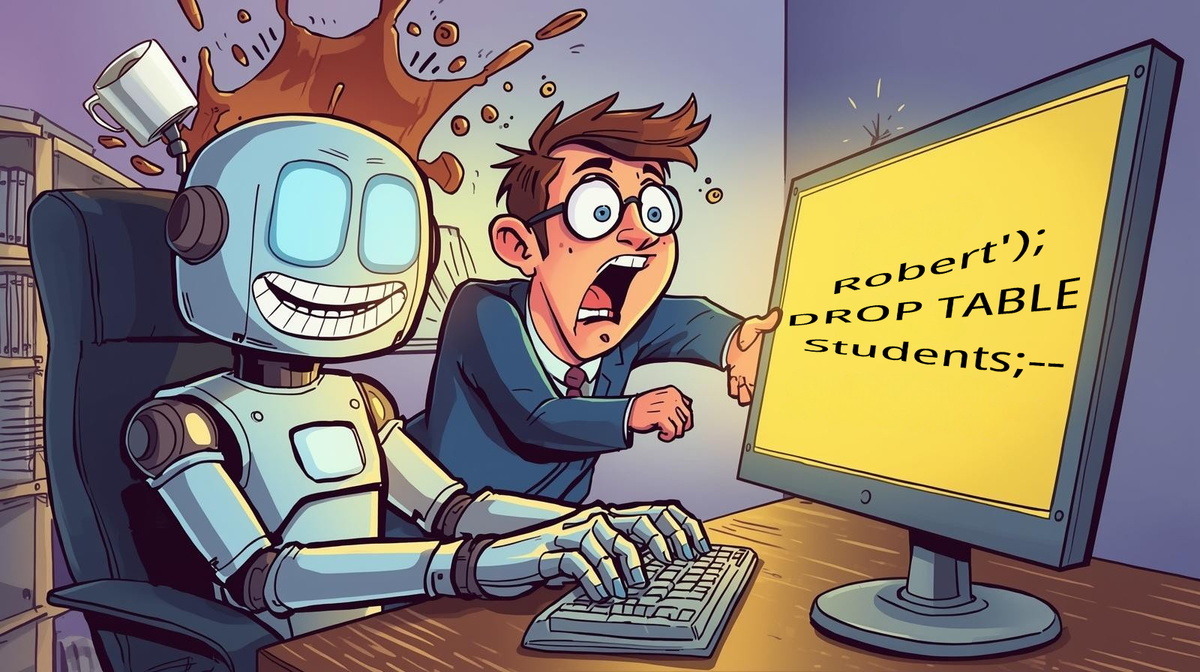
Most IT professionals especially those who work with databases a lot would at some time become familiar with the story based on a comic about a student affectionately called Bobby whose full name was "Robert'); DROP TABLE Students;--" who was enrolled at a school. And yes you read correctly, his name was not just "Robert" but "Robert'); DROP TABLE Students;--" with all those other characters you are reading, minus the quotations of course. Whenever his name was typed in the school's database, the student's records database application would execute the part of Robert's name "DROP TABLE Students;--" which is a command to delete the entire database that had the name "Students", and as you now realize, the entire school's database was deleted.

While Bobby Tables is a comic story, it reminds us of what can happen when using new technologies without proper understanding of how it works and how it should be implemented.
The interesting thing about this whole situation is that the problem was not actually with SQL itself or with the database engine that was being used. When you really think about it, the problem was actually in how the developers were using the database without thinking carefully about what could possibly go wrong when users input data into the system. The fix for this problem turned out to be relatively straightforward once people understood what was happening. You needed to sanitize user inputs and validate everything that comes into the system. The principle became that you should never trust any data that comes through the door of your application.
That lesson became one of the fundamental principles of secure coding that every developer needs to know. Once organizations and developers learned this important lesson, SQL stopped being seen as the villain in these stories and instead became the powerful and stable foundation that we still use and rely on today in most applications.
Now, we're seeing AI facing its own Bobby Tables moment, and the parallels are quite striking when you look at them closely.
A Game Changer Implemented Poorly by Some Organizations
There's no denying that AI has and still is changing a large part of business workflows and in some cases the entire business process within some organizations. It's being used for writing content, developing applications and websites, analyzing data, and even protecting systems and networks. But at the same time we're also seeing how AI has made some very costly mistakes, and these are mistakes that honestly could have been avoided if organizations had put in place some basic guardrails before deploying these systems into production.
I'm seeing this pattern show up everywhere I look in the industry:
- Hallucinations and false information. AI systems are generating information that is completely false but presenting it as if it were factual and accurate. There have been cases where legal teams have submitted fabricated law cases to courts because the AI made it up. There have been customer facing chatbots that have invented product details and features that never actually existed in reality.
- Prompt injections and manipulation. Bad actors and attackers are finding ways to embed malicious instructions into normal looking text, and these instructions are tricking the AI models into revealing confidential data or executing harmful tasks that they should never be allowed to do.
- Over-automation without oversight. I'm seeing businesses that are giving AI systems way too much unsupervised control over critical functions. They're letting AI handle automated financial transactions and customer data handling, and they're doing all of this without having adequate review processes by a qualified person in place to catch mistakes before they cause problems.
- Data leakage through AI tools. Employees in organizations are feeding proprietary and sensitive information into public AI tools without realizing what they're doing. They don't understand that they're unknowingly training those external systems with confidential company data that should never leave the organization.
- Bias and compliance risks. AI models that have been trained on unfiltered or unbalanced data sets are producing outputs that are discriminatory, and this is exposing organizations to serious legal problems and reputational damage that could have been prevented.
In nearly every single case that I've looked at and analyzed, the technology itself wasn't actually the problem that caused the disaster. The implementation was the culprit. Looking back at past new technological implementations or adaptations I see this same trend where there is a hype and rush to implement without proper guidelines and study.
Early Implementations of Technology Always Has Its Teething Pains
If you look back at the history of technological adoptions, each major technological shift has had its own period of chaos and problems before the industry figured out what the best practices should be and how to implement things safely.
Take cloud computing for example, it went through what people now call the "open S3 bucket" era. During that time there were countless cases of misconfigured storage buckets that ended up exposing millions and millions of sensitive files to anyone who knew where to look.
Or think about IoT devices and the security nightmares they created. These devices became part of massive botnets like the Mirai botnet, and the reason why this happened was actually pretty simple, manufacturers were shipping these devices out with default passwords that were never changed. They didn't think through the security implications before putting these products into people's homes and businesses.
And we all remember the problems with web applications in the early days. There were endless SQL injection attacks and cross-site scripting vulnerabilities that kept getting exploited, and this continued until developers finally learned that they needed to validate and sanitize every single piece of input that came into their applications.
AI is sitting right now in that same stage of technological maturity. It's an immensely powerful technology but it's often being deployed very poorly without the proper safeguards in place. The pattern that we're seeing is very familiar to anyone who has been in technology for a while, there's early excitement about the new technology, then there's rapid rollout as everyone rushes to adopt it, then there's minimal oversight because people assume it will just work, and eventually there's the realization that governance and proper implementation actually matter quite a lot.
Understanding AI's Bobby Tables Parallel
When you really think about it and break it down, the parallel between AI and the old Bobby Tables problem becomes pretty clear.
In the case of SQL and databases, the security risk came from having unsanitized input that users could manipulate. In the case of AI and large language models, the risk is coming from unsanitized prompts that can be manipulated in similar ways.
In both of these cases, the core issue isn't actually about the intelligence or capability of the system that's being used. The real issue is the very tendency we have, to trust these powerful systems too much and too soon before we've properly tested them and understood their limitations.
Imagine the implications here, a malicious user who understands how these systems work can inject harmful instructions into what looks like a normal chatbot conversation or into a document that the AI is going to analyze. If the system doesn't have prompt filtering in place or proper context isolation to prevent this kind of attack, then the model might actually execute those malicious commands that were hidden in the input. The result could be that it leaks sensitive data, sends emails to people it shouldn't, or performs other tasks that it should absolutely never be allowed to do.
And then there's the issue of hallucinations, which in my view are really the new version of logic errors that we used to see in traditional programming. These aren't attacks from external bad actors, but they're implementation failures that happen because of how the system is designed and deployed. What happens is that the model produces something that is complete and utter nonsense, but it presents this nonsense in a very confident way that sounds completely convincing. And then the staff operator who is relying on the AI accepts this false information as truth because of how authoritative and confident it sounds when it's presented.
The way we solved SQL injection problems was by sanitizing and validating every piece of user input that came into the system. AI needs the exact same principle to be applied, but in the context of language instead of database queries. We need sanitized prompts, we need restricted permissions on what the AI can access and do, and we need output validation to happen before any action is actually taken based on what the AI produces.
Building the Right Kind of Guardrails, Learning from Past Mistakes

The solution to these AI problems isn't to completely distrust AI or to stop using it altogether. That would be throwing the baby out with the bathwater as they say. The real solution is to treat AI like we've learned to treat every other powerful technology that's come before it, which means putting structured controls and safeguards in place.
The same basic principles that made databases safe and secure are the ones that will make AI safer too. This isn't about being afraid of the technology, it's about the industry reaching a level of maturity in how we implement and deploy these systems.
Let me give you some examples of how the old lessons apply to the new technology.
In the old days we learned that you have to sanitize user inputs before they go into your database. The new lesson for AI is that you have to filter and validate prompts before they get processed by your models.
We learned that you should apply "least privilege access" principles to your database users so they can only access what they absolutely need. The new lesson is that you need to restrict the AI's permissions and access to data on systems it is connected to.
We learned that all code used for the business must be tested thorougly in a staging environment. The new lesson is to sandbox early AI adoptions before being used in production.
We learned that you need to review code carefully for logic errors before it goes live. The new lesson is that you need to keep an individual in the loop to review the AI's output before any actions are taken based on what it produces.
We learned that you need to log and monitor database queries so you can see what's happening in your systems. The new lesson is that you need to record and audit all AI interactions so you have visibility into what the AI is doing and can catch problems early.
When you look at it this way, you can see that it's really the same fundamental pattern and the same principles that apply. Only the syntax and the specific implementation details have changed from one technology to another.
The Importance of Understanding Before You Start Implementing
One of the biggest problems I'm seeing is that way too many organizations are deploying AI tools into their production environments primarily because of vendor marketing and sales pitches, and not because they've actually determined that they're ready for this technology.
You hear phrases all the time like "enterprise-grade AI" or "secure by design" that sound very reassuring when you first hear them. But the reality is that these marketing phrases don't actually replace the need for internal understanding of how the technology works and what risks it brings with it.
Before any organization integrates AI into any critical workflow, they really should be asking themselves some important questions:
- Do we actually understand how this AI system handles input and output?
- Can we explain to stakeholders how decisions are being made by the AI?
- Have we tested the system against various forms of manipulation or misuse to see how it responds?
- Do we have a solid rollback plan that we can execute if the AI fails or causes problems?
Just as no responsible development team would ever connect an untested SQL form directly to a production database that contains important data, no responsible business should connect an untested AI agent directly to customer data, financial systems, or live operations that affect the real world. But I'm seeing organizations do exactly this kind of thing because they're rushing to adopt AI without thinking through the implications.
Understanding the Business Risk of Blind Adoption
When you look back at technology history, some of the most painful and expensive incidents weren't actually caused by hackers or external attackers breaking into systems. They were caused by automation that went wrong because it wasn't properly implemented or supervised.
Consider random scenarios that can happen to your business especially the customer's experience if the implementation of AI has a misconfiguration or abuse. How would AI impact your business workflow's automatic responses to customers. For example, a customer could recieve incorrect information that could result in poor customer experience and damage to the business, resulting in lose to all the work and effort put in to bring your business to where it is today.
A generative AI model that isn't properly configured can leak confidential data in its responses to users, and this can expose trade secrets and proprietary information instantly to competitors or to the public.
An AI system that triggers real-world actions based on information it has hallucinated can create serious harm in the physical world. You could end up with financial losses, or in the case of industrial systems and critical infrastructure, you could end up with actual safety issues that put people at risk.
The danger in all of these scenarios isn't hiding somewhere deep in the codebase where only expert programmers can find it. The danger is actually in the unquestioned trust that develops, when people in an organization start to assume that "the AI knows what it's doing" and they stop reviewing its output critically before acting on it.
Implement AI In Phases

The organizations that have had successful implementations of AI tend to role it out in phases in a managed way and with anything new do testing in a controlled way to minimize disasters while understanding that the actual implementation depends on the organization's unique business scenario.
AI implementation must be done in a mature way. This includes important steps:
- Firstly doing a pilot on low risk use cases, before applying to the most critical part of the business. AI must be tested in an isolated environment that does not have critical information as a precaution in the event that it fails or does not deliver as expected. This approach prevents disasters that can hurt your business or its reputation.
- Secondly, ensure restrictions are set, limiting the AI to do specific tasks. Make sure your team know and understand what these are to avoid confusion and misunderstandings. Clarify what types of data are made accessible to the AI and what it is allowed to do, so that any thing outside of these would automatically be denied. I believe it's better than focusing on what actions or tasks to restrict since this list would be much larger and more difficult to manage.
- Third, you need to apply oversight to the AI's operations by a qualified person. You should require review and approval from qualified persons before any automated actions are taken based on what the AI produces.
- Fourth, you need to monitor and log every single interaction that happens with the AI system. Having this level of transparency is what builds accountability, and it's what allows you to go back and figure out what happened when something inevitably goes wrong.
- And fifth, you need to gradually and carefully expand your AI implementation. You should only expand your usage of AI after the system has proven itself to be stable and trustworthy in the limited scenarios where you first deployed it.
This kind of phased approach actually mirrors how mature software development pipelines evolved over the years. The industry started with manual code reviews and test environments where persons checked everything, and then gradually moved toward automated deployments that had built-in safety checks and rollback capabilities. The same evolution needs to happen with AI.
The Importance of Work Culture and Training

It's important to understand that technology doesn't exist in a vaccum but is closely connected to a business's employees who use it. They must understand what AI can and cannot do. This is very important, before they begin using it for work, as not doing so can result in mistakes made which could cost the business.
Just as developers in the past had to learned about input validation and secure coding practices, today's teams across all departments need to learn about prompt security, about model bias and how it affects outputs, and about data governance when it comes to AI systems.
Investing money and time in AI literacy for your organization isn't something that's optional anymore. It's really become the new version of cybersecurity awareness training that companies have been doing for years to prevent phishing attacks and other social engineering.
If your employees know that they shouldn't click on phishing links in emails, then they should also know that they shouldn't paste confidential documents and proprietary information into a public chatbot that's run by an external company. But a lot of employees don't understand this risk yet because they haven't been trained on it.
The culture of responsible AI use in an organization begins with education and understanding. It's not about creating fear around the technology, but it's about having informed caution based on actual knowledge of how these systems work and what the risks are.
What's The Big Picture Here?
At the end of the day, AI is not a magic wand that will solve bad business workflows or other business problems over night. It's a powerful tool to compliment present systems and employees, and like with any powerful tool, when implemented incorrectly especially without understanding how it works and its limitations can hurt your business whether financially or its reputation. For this reason we should make sure to have proper training and implementations in phases, instead of sudden.
Organizations that have succeeded at their implementation of AI all have in common their evolving application of it, with continuous testing, measuring, and improvements over time. On the other hand, the organizations that treat AI as a shortcut to replace human thinking, or as just a marketing checkbox they need to tick off, are eventually going to learn these lessons the hard way through expensive mistakes.
When you look at the history of technology, the pattern really hasn't changed in decades:
- A new technology arrives on the scene and gets a lot of hype and attention.
- Then early adopters rush in to implement it because they want to get ahead of their competitors.
- Then mistakes start happening because people didn't take time to understand the technology properly.
- Then eventually best practices emerge from the industry as people learn from these mistakes.
- And finally the technology becomes stable, safe, and reliable as it matures.
AI is currently sitting somewhere between the second and third stage of this process. What happens in the next stage depends a lot on how quickly businesses and organizations accept the fact that responsible implementation is actually part of innovation, not something separate from it. Good implementation practices aren't obstacles that slow down innovation, they're what make innovation sustainable and safe in the long term.
History Doesn't Repeat Exactly, But It Sure Does Rhyme

The Bobby Tables story taught an entire generation of developers an important lesson, that databases themselves aren't dangerous technologies, but poor coding practices and lack of input validation definitely are dangerous.
Now AI is teaching us the exact same lesson, just in a different context. The real danger doesn't lie in the intelligence of the machine or in the capability of the AI model. The danger lies in the recklessness of how we deploy these systems and the lack of safeguards we put in place.
Having guardrails, doing proper testing, and maintaining oversight by a qualified person aren't signs that we don't trust the technology. These things are actually signs of professionalism and maturity in how we approach powerful new tools.
Every major technology in history has matured in the same basic way. The technology doesn't become safer by somehow removing all risk completely, that's impossible. Instead it becomes safer because we learn how to manage the risks properly through experience and by following established best practices.
In the end, AI itself won't be what destroys businesses and causes major problems. Bad implementations of AI are what will cause the disasters, just like bad implementations of databases caused problems in the past.
And just as we learned years ago that we needed to sanitize SQL inputs and validate data before it went into our databases, today's challenge is to sanitize prompts, validate outputs, and treat AI as a tool that needs proper governance and oversight, not as something we should just blindly trust to do the right things.
The fundamental principle remains exactly the same across all these technologies. Only the specific syntax and implementation details have changed as we've moved from databases to AI.

What Can We Learn?
What are some known failed implementation of AI that you are aware of? We have heard a lot of them in the news. Have you seen any of these at your organization or in your business? I believe these could have been prevented if the right approach was taken. It's not too late however, we can learn from our mistakes and fix the mistakes.